
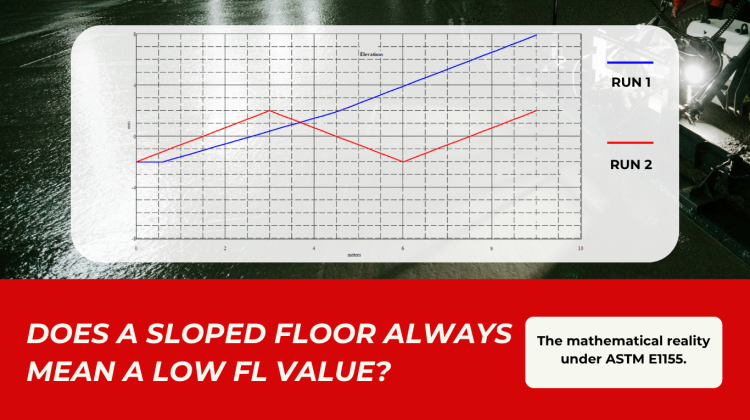
Floor Levelness (FL) under ASTM E1155: Why It Does Not Simply Mean Floor Tilt
Floor Levelness (FL) under ASTM E1155: Why It Does Not Simply Mean Floor Tilt
ASTM E1155 is widely used internationally to evaluate the flatness and levelness of concrete floors. The standard uses statistical analysis to convert floor-profile data into two dimensionless values:
FF – Floor Flatness
FL – Floor Levelness
In general, higher FF and FL numbers indicate a flatter and more level floor.
Common Understanding of FL
Many floor-flatness inspectors commonly interpret Floor Levelness (FL) as a measure of floor tilt or slope.
Under this interpretation, a floor with a higher slope is considered less level and would therefore be expected to produce a lower FL value.
This understanding is generally reasonable, but it does not fully explain what the FL number actually represents.
What the FL Formula Really Measures
When we study the ASTM E1155 FL calculation, we can see that FL is not controlled only by the average slope of the floor.
A major factor affecting the calculated FL value is the standard deviation of the Z values, where:
Z = elevation difference over a 3-meter distance
In simple terms, Z represents the local slope over 3 meters.
However, FL is influenced not only by the slope itself, but also by how much these 3-meter slopes vary along the measurement run.
Therefore, FL is affected by two key components:
1. The average Z value
This represents the general slope tendency of the floor.
2. The standard eviation of the Z values
This represents the variation, or rate of change, of the local slopes.
This distinction is important because the rate of change of slope is not the same as the slope itself.
Practical Example
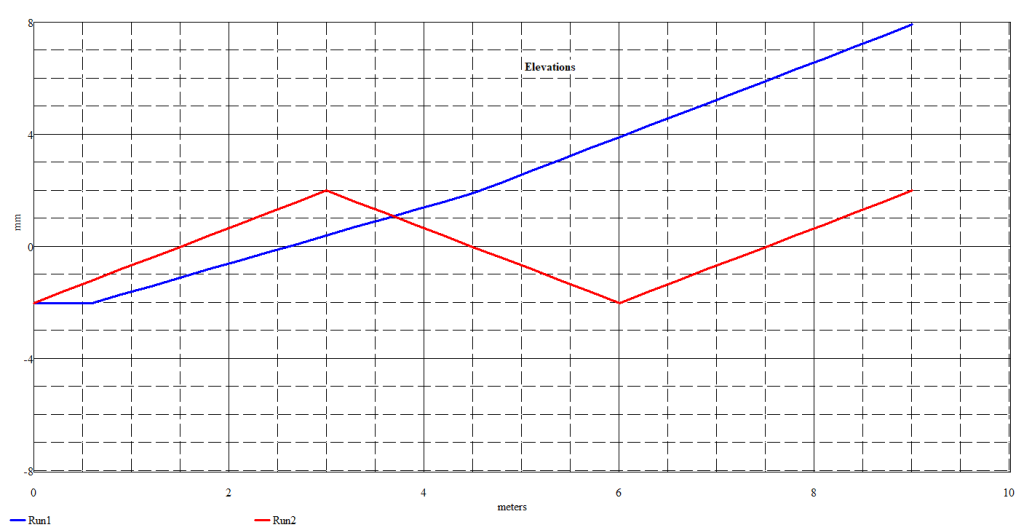
In the photograph below, two measurement runs are shown, each with a length of 9 meters.
At first glance:
Run 1 appears to have a greater overall slope than Run 2.
However, the measured FL results are:
Run 1: FL 63.65
Run 2: FL 41.07
This means Run 1 has an FL value more than 50% higher than Run 2, even though Run 1 visually appears to have more slope.
This example clearly illustrates that the measured FL value does not simply represent the visible tilt or overall slope of the floor.
Key Technical Interpretation
From this perspective, FL should not be understood only as a measure of floor slope.
A more accurate interpretation is that FL reflects the long-distance consistency of elevation change across the floor.
While FF is generally associated with short-distance flatness, FL may be better understood as a form of long-distance flatness or long-wavelength profile consistency.
Conclusion
Floor Levelness under ASTM E1155 is more complex than simple floor tilt.
Although slope is part of the FL calculation, the variation of 3-meter elevation differences plays a major role in the final FL number.
Therefore, a floor can appear more sloped but still achieve a higher FL value if its slope changes more consistently along the measurement run.
In practical terms:
FF reflects short-distance flatness.
FL reflects long-distance elevation consistency, not merely floor tilt.