
Defined-Movement Floors: TR34 DM & ACI F-min Requirements for VNA Warehouses
In modern high-density warehouses, Very Narrow Aisle (VNA) systems allow operators to maximize storage capacity by reducing aisle widths and increasing racking height. However, these systems place significantly greater demands on the concrete floor.
Unlike conventional warehouse areas where forklifts can travel freely in different directions, VNA trucks operate repeatedly along fixed travel paths. For this reason, the floor must be evaluated as a Defined-Movement or Defined-Traffic floor, with flatness and levelness assessed specifically along the actual wheel tracks of the Material Handling Equipment (MHE).
Two commonly used approaches for defined-traffic floor assessment are:
- TR34 4th Edition Defined Movement – DM1, DM2 and DM3
- ACI F-min – Defined Traffic Floor Classification
Both systems are designed to control the floor profile experienced by the VNA truck, but they use different properties, measurement intervals and acceptance criteria.
What Is a Defined-Movement Floor?
A defined-movement floor is a floor where material handling equipment travels repeatedly along predetermined paths.
This is most commonly associated with Very Narrow Aisle warehouses, where the truck typically moves only forward and backward within a defined aisle. The wheel positions therefore follow essentially the same tracks throughout operation.
Because the truck follows these fixed paths, measuring the general flatness of the entire warehouse floor is not sufficient. The floor profile must be evaluated specifically where the wheels of the VNA truck will travel.
The exact geometry of the MHE is therefore an important part of the assessment. In particular, the truck supplier should provide the relevant:
- longitudinal wheel spacing; and
- transverse wheel spacing.
Different trucks may have different configurations, including three-wheel and four-wheel arrangements. These dimensions directly affect how the floor is measured and evaluated.
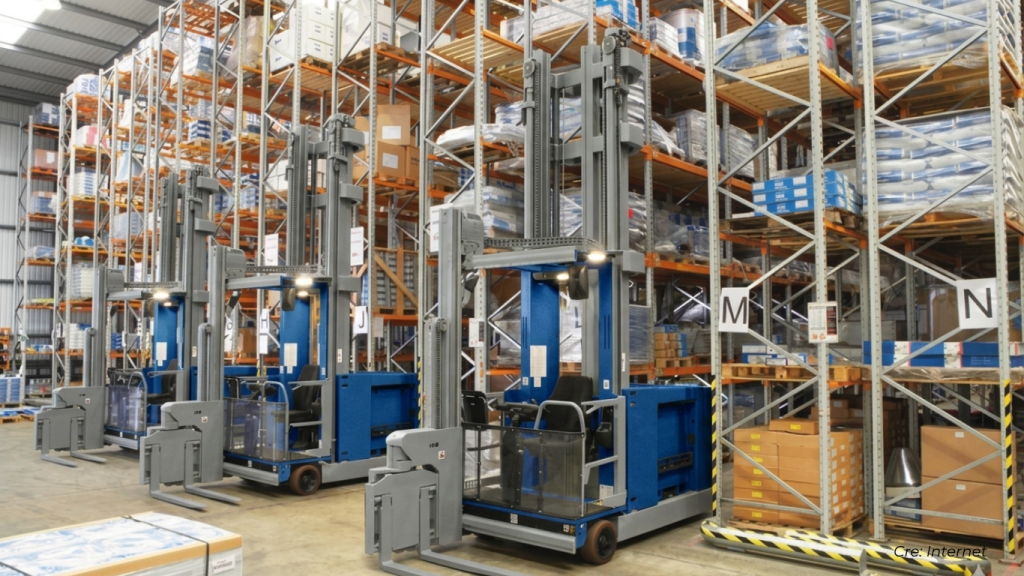
Defined Movement Floor Illustration
TR34 4th Edition – Defined Movement Classification
Under TR34 4th Edition, defined-movement floors are classified as DM1, DM2 and DM3.
The appropriate classification is primarily related to the operational requirements of the warehouse, including racking height. The DM system evaluates both flatness and levelness along the defined wheel paths of the VNA truck.
Measuring a TR34 DM Floor
TR34 requires the defined wheel tracks to be measured using a Profileograph, with elevation data collected at regular 50 mm intervals.
The measurement lines are positioned according to the actual wheel tracks of the VNA truck within each aisle. This produces a continuous representation of the surface that the truck wheels will experience during operation.
For VNA applications, this is important because relatively small changes in elevation can affect the truck as it travels at height.
The Four Main TR34 DM Properties
1. Property dZ – Transverse Levelness
dZ represents the elevation difference between the centres of the truck’s front wheels. In practical terms, it indicates how much one side of the truck is higher or lower than the other at a particular point in the aisle. This is particularly important for high-level VNA operation because transverse floor variation creates sideways truck inclination.
2. Property dX – Longitudinal Levelness
dX represents the elevation difference between the centre of the front axle and the centre of the rear axle. It describes the truck’s longitudinal inclination as it travels along the aisle.
3. Property d²Z – Transverse Flatness
d²Z represents the change in dZ. Rather than simply measuring the truck’s transverse inclination, this property evaluates how that inclination changes as the truck travels forward.
4. Property d²X – Longitudinal Flatness
d²X represents the change in dX. It therefore evaluates changes in the longitudinal tilt experienced by the truck.
Additional Parameters Used in TR34 DM Measurement
Z – the transverse distance between the centres of the truck front wheels.
X – the longitudinal distance between the centres of the front and rear axles. A fixed value of 2 m is used for this property.
ZSLOPE – the cross-aisle slope between the centres of the front wheels, expressed in mm/m.
The transverse truck dimension is therefore particularly important when assessing a specific VNA system.
TR34 DM1, DM2 and DM3
TR34 provides different tolerances depending on the specified Defined Movement classification.
| Classification | Typical Racking Top Beam Height | ZSLOPE |
| DM1 | Over 13 m | 1.3 mm/m |
| DM2 | 8–13 m | 2.0 mm/m |
| DM3 | Up to 8 m | 2.5 mm/m |
In addition to ZSLOPE, the TR34 classification establishes limits for dZ, d²Z, dX and d²X. In general, the higher the racking system, the more demanding the defined-movement floor requirement becomes.
All relevant point elevations are measured at 50 mm intervals along the wheel-track measurement lines to determine compliance with the four main DM properties.
ACI F-min Defined-Traffic Floors
Another widely used approach for defined-traffic floors is the F-min system.
Under this system, the defined traffic floor is controlled using an F-min value that represents both flatness and levelness over the wheel paths of the vehicle that will operate on the floor.
Importantly, F-min is not intended to describe the general condition of the entire warehouse slab.
An Fmin50 floor, for example, means that a specified vehicle travelling along its specified travel path should not encounter a slope or change in slope greater than the limits associated with the Fmin50 requirement.
Measuring an F-min Floor
The F-min floor is also measured using a Profileograph, with measurement lines aligned with the actual truck wheel tracks.
Data for the F-min assessment is taken at regular 50 mm intervals along the defined travel paths.
The Four Main F-min Properties
Longitudinal F-min Levelness – This relates to the longitudinal tilt of the material handling equipment.
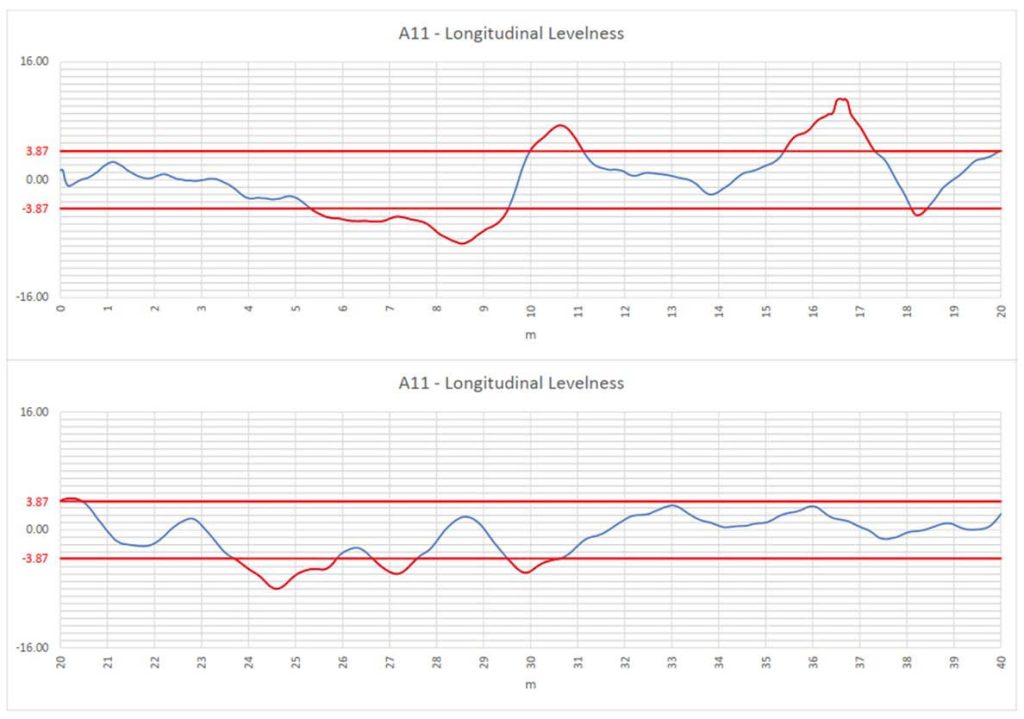
Longitudinal Levelness
Transverse F-min Levelness – This relates to the transverse tilt of the material handling equipment.
Longitudinal F-min Flatness – This relates to the rate of change of the longitudinal tilt as the truck moves.
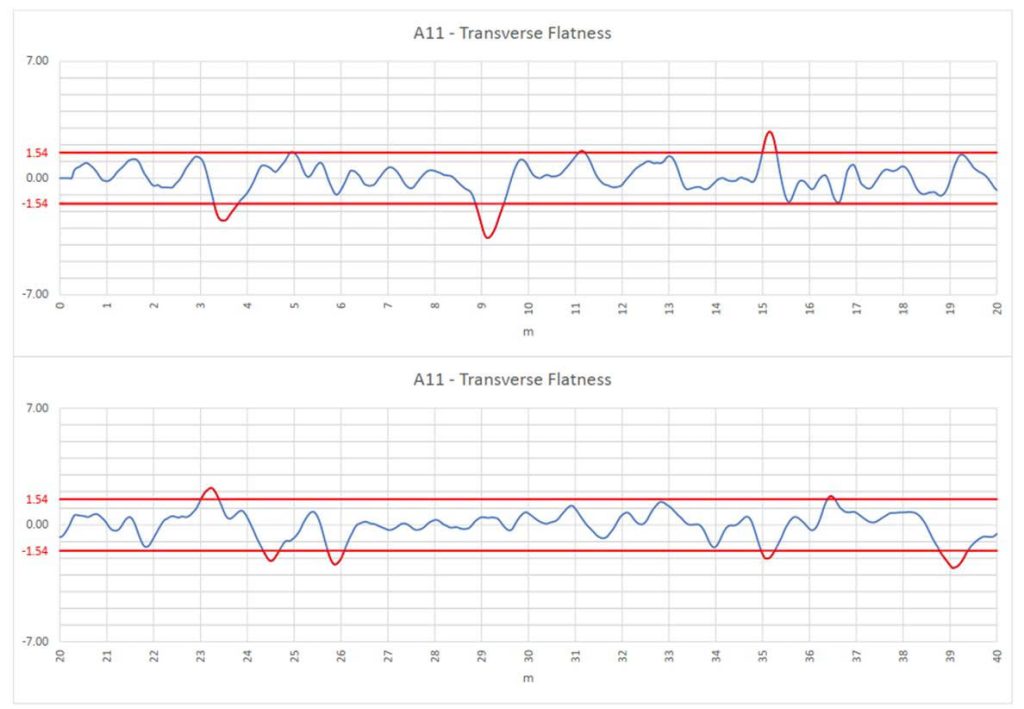
Transverse Flatness
Transverse F-min Flatness – This relates to the rate of change of the transverse tilt as the truck moves.
Selecting an F-min Requirement
The source document reproduces ACI 360 guidance relating rack height to longitudinal and transverse F-min requirements.
| Rack Height | Longitudinal F-min | Transverse F-min |
| 0–7.6 m | 50 | 60 |
| 7.9–9.1 m | 55 | 65 |
| 9.4–10.7 m | 60 | 70 |
| 11.0–12.2 m | 65 | 75 |
| 12.5–13.7 m | 70 | 80 |
| 14.0–15.2 m | 75 | 85 |
| 15.5–19.8 m | 90 | 100 |
| 20.1–27.4 m | 100 | 125 |
The longitudinal value is evaluated between the front and rear axle positions, while the transverse value relates to the loaded wheel tracks. The measurement lines are again positioned according to the actual wheel tracks within each VNA aisle.
Why VNA Floor Flatness Matters
As warehouse racking becomes higher and aisles become narrower, the relationship between the truck and the floor becomes increasingly important.
Small differences in wheel elevation create truck inclination. Changes in those differences create vibration as the truck travels through the aisle.
A properly specified and measured defined-movement floor therefore helps ensure that the warehouse floor is appropriate for the intended material handling system.
This is why floor requirements should ideally be established with consideration of:
- proposed racking height;
- VNA truck type;
- longitudinal wheelbase;
- transverse wheel spacing;
- selected floor standard; and
- required DM or F-min classification.
Defined-Movement Floor Measurement by PCE
PCE provides specialist floor profile measurement for Very Narrow Aisle floors, including assessment in accordance with TR34 4th Edition Defined Movement – DM1, DM2 and DM3 and ACI F-min defined-traffic requirements.
Measurements are carried out along the defined wheel tracks so that the floor can be evaluated against the operational requirements of the intended Material Handling Equipment.
For new warehouse projects, measurement can be used to verify floor compliance before VNA operation. For existing warehouses, defined-movement measurement can also identify locations where the floor profile does not comply with the required tolerance and where corrective floor upgrading may be necessary.